


Rob Kouba and Battles of Westeros
Rob Kouba answers more than ten questions about Battles of Westeros at The Hopeless Gamer.






Rob Kouba answers more than ten questions about Battles of Westeros at The Hopeless Gamer.
The Hopeless Gamer has an excellent and detailed battle report on the upcoming Battles of Westeros ‘BattleLore’ game. More information is promised soon. Check it out.
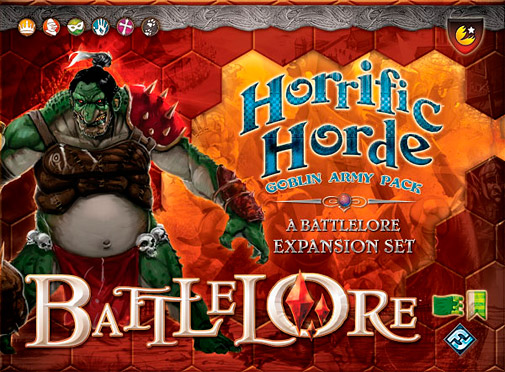
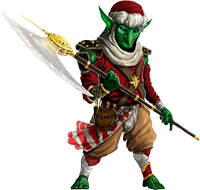 A big surprise from Fantasy Flight Games this morning with the announcement of the BattleLore: Horrific Horde expansion set!
It’s an interesting release, for several reasons. Firstly, veteran players will probably not get too excited about the 42 figures in this set: we’ve seen the Goblin Swordsmen, Hobgoblin Cavalry and Hobgoblin Hyena Riders before (interestingly, there are no Drummers, Spear Bearers and Slingers from the Goblin Skirmishers set, so it isn’t really an entire Goblin army). The only new units are some Goblin Halberdiers, and some fantastic-looking Ogres.
However, what this new set does tell us is that FFG are listening to the fans and releasing large expansion sets of one racial type. I think I can safely predict that a big dwarf set will be the next release, consolidating some of the units from the Dwarven Battalion and Scottish Wars sets, plus some new Dwarf units. But after that, perhaps we’ll finally see new BattleLore races on the battlefield?
 (As a personal aside, I would love to see the sculpt for green and blue banner goblins replaced. It never seemed to match the style and scale of the other goblin figures.)
Anyway, back to the Horrific Horde! As well as the figures, you get unit summary and specialist cards, weapon summary cards for the updated Goblin Slinger rules, 15 deployment cards to use with Call to Arms, and a rulebook with five new Adventures. I would guess that this all comes in a box the size of the Scottish Wars and Heroes expansions.
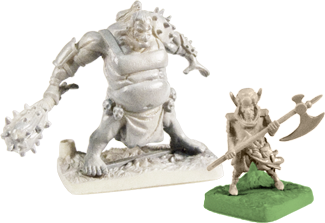 The Ogre is a great looking figure and certainly has a lot more ‘oomph’ than the Troll sculpt. It can move one hex and battle, and wields a spiked club for 4d, hitting on a bonus strike; it’s also subject to a ‘Frenzy’ rule. Also, a unit consists of three figures, which is something new, so it’s a red banner unit not a creature.
Is the start of a new series of much-awaited army packs? Elves, undead, orcs …?
The Horrific Horde is coming this (northern hermisphere) summer.
Fantasy Flight Games has released a little bit of information about the upcoming ‘BattleLore spinoff’ Battles of Westeros. There’s our first glimpse of some nice-looking terrain tiles (it would be great if these were compatible with existing BattleLore), and news that the board can be played in both the normal horizontal configuration (which you can expand with add extra boards) and a long lengthwise configuration. But most radically, there are no flanks on the board. Instead, in most circumstances you can only order units if they are controlled—that is, within two hexes of a commander.
For more detail, visit the Fantasy Flight website.
If you do, get on over to The Hopeless Gamer and ask it!
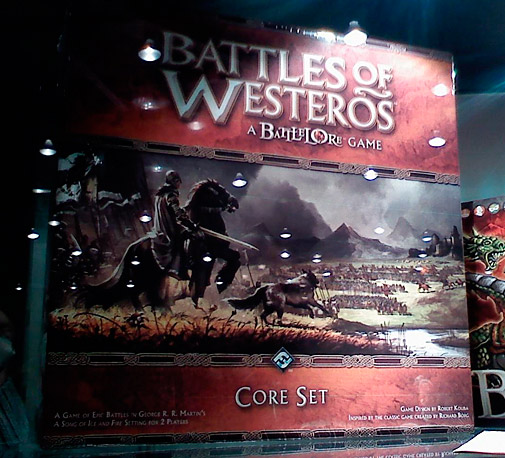
Information has just come in that a new BattleLore core set has been announced at Sunday’s Fantasy Flight Games Event Center opening.
Fantasy Flight Games has created a BattleLore game set in George R. R. Martin’s A Song of Ice and Fire setting, the ‘realistic’ medieval fantasy world already licenced by FFG in A Games of Thrones: The Board Game and A Game of Thrones LCG.
Game design is by Robert Kouba, ‘inspired by the classic game created by Richard Borg’. Kouba has in the past worked on expansions for Descent, Starcraft, and Tide of Iron.
Game Contents
1 Rulebook
1 Westeros Battle Plans Book
1 Six-panel Map Board
138 Plastic Figures
138 Plastic Bases
36 Banner Poles
8 Custom Dice
110 Cards
2 Command Boards
1 Round Track and 1 Round Marker
2 Victory Point Markers
2 Morale Segments, 1 Moral Hub and 1 Morale Marker
50 Order Tokens
86 Unit Banners
14 Control Markers
6 Directional Tokens
20 Engagment Tokens
32 Overlay Map Pieces
3 Archer Tokens
6 Devestation Tokens
13 Tactical Objective Tokens
18 Fire Tokens
1 Catelyn Stark Token, 2 Edmure Tully Tokens
7 tent Tokens
8 Siege Tower Tokens
9 Catapult Targeting Tokens
10 Commander Discs
1 Momentum Token
Interesting that the figures seem to come with separate bases. It’s obvious from a look at this list that this new game is going to be somewhat more complex that basic BattleLore—just look at all those extra tokens for a start! It would also appear that the new game will put magic in the background—if not out of the picture entirely—as I believe the books do not feature magic at all.
For continuing coverage, visit The Hopeless Gamer blog, who is currently posting about the game, including some images of the miniatures. Thanks go to that blog for the photo and information posted above. No doubt the official launch on the Fantasy Flight Games website will be tomorrow!
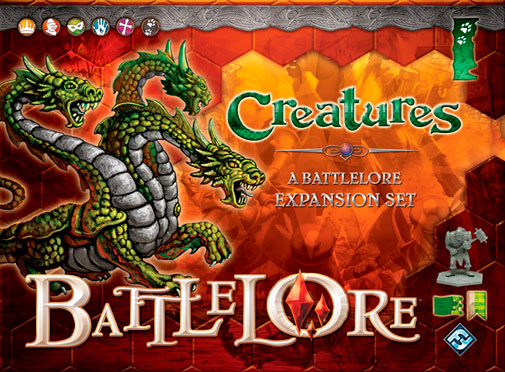
Next up from the series of previews from Fantasy Flight Games is a look at the cards for the three creatures (two of which are models we’ve seen before, the Giant and Elemental, previously only available as promo figures) in the upcoming BattleLore: Creatures expansion set.
Again, it’s mostly flavour text, but we do see the cards for the Wood Giant (Green banner), Hydra (Blue banner) and Rock Elemental (Red banner).
 The Wood Giant moves up to 2 hexes and battles, and retreats 2 hexes per flag. His damage is 2 dice. Being a denizen of the forests, he ignores the movement and combat restrictions of woods, so he can move through them and also battle on a turn he moves into them. Each bonus strike is re-rolled for additional hits or flags until no more bonus strikes are rolled. The Giant player can force his target to retreat 2 hexes for every Lore he rolls.
 The Hydra is going to be the figure everyone will want from this set, with its interchangeable heads. It may move up to 2 hexes and battle, and retreats 2 hexes per flag. It’s melee damage is 1 dice plus 1 dice per head, and it also hits on a bonus strike symbol. The Hydra is only hit on its banner colour, and one neck is removed for each hit! The fun continues when a Hydra rolls a Lore symbol in melee—if it is missing a neck, a neck with 2 heads can take its place! Great stuff.
 The red Earth Elemental is a magical force to be reckoned with. It moves a number of spaces equal to the Lore you spend (ignoring movement and terrain restrictions), it does not retreat, and it has a melee attack of 4 dice. It’s melee attack does a big 4 dice damage and hits on a bonus strike. It’s 1 Lore Tremor attack makes all surrounding units retreat one hex for each Lore, and its 2 Lore dice Earthquake attack makes all surrounding units take 1 hit and retreat.
However, the Earth Elemental must be kept on the go—if it is not ordered in a turn it is removed and must be summoned again.
Previews of the actual figures and the dragons soon, hopefully.
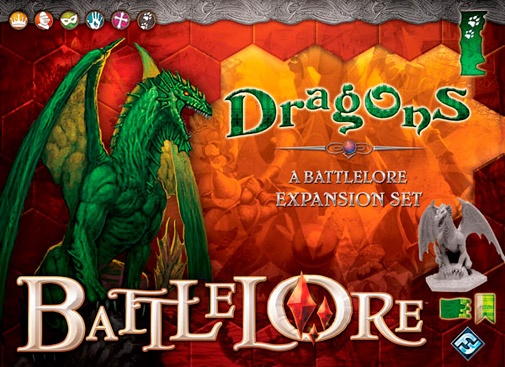
The information from Fantasy Flight Games just keeps pouring in—now, a look at the abilities of the three types of dragons in the upcoming BattleLore: Dragons expansion set.
The article is mainly flavour text, but it does show us the abilities and attacks of the three types: the Wood Wyvern (Green banner), Ice Drake (Blue banner) and Fire Dragon (Red banner).
 All the basic information is the same, except the melee attack damage, which is 2 dice for the Wyvern, 3 dice for the Drake and 4 dice for the Fire Dragon. All the Dragons hit on a Bonus Strike result. As for movement, they can all move up to 2 hexes and battle, or fly up to 4 hexes and then use their breath attack. Retreat is 3 hexes per flag, with the option of ignoring the first flag.
 Dragon are certainly going to be dominant, fast-moving features on the battlefield, and when Lore is paid (1 for the Wyvern, 2 for the Drake, and 3 for the Fire Dragon), the hexes that are flown over are going to feel the effects of their horrific breath weapons! The Wood Wyvern can unleash a Poison Breath attack that does 2 dice damage against every hex flown over. Each Lore rolled equals a Poison Breath token, the effects of which are still unclear.
 The Ice Drake has a Frost Breath attack that does 3 dice damage and each Lore rolled equals a Frost Breath token, and the Fire Dragon’s Fire Breath attack does 4 dice damage and doles out Fire Breath tokens.
No doubt we’ll soon find out the additional effects of these Breath tokens. Dragons and Heroes are certainly going to shake up the battlefields of BattleLore however!
The Rules for BattleLore: heroes are now available to download from the Fantasy Flight Games BattleLore Support page. Also, the expansion comes with a pad of Hero record sheets, but you can download more directly from this page.
Fantasy Flight games has announced that the Dragons and Creatures expansions—yep, two separate expansions—will be available before the end of the year.
See the video of CEO Christian Petersen’s GenCon speech here at the Fantasy Flight website (click the Friday clip). The announcement is about three-quarters of the way through.
You can see the spectacular multi-headed Hydra, which comes with the old hill giant and earth elemental figures, here, and the packaging for both sets here.
According to information on the FFG forums by people at GenCon, Dragons comes with three figures: the Fire Dragon is a red banner creature, the Ice Drake is blue, and the Forest Wyvern is green. You need two hits to trigger your critical hit roll, and always roll one die less than normal. They all have the Fly ability and have a 4 dice attack.
Creatures will include the Rock Elemental and the Forest Giant (the same figures as before but renamed) as well as a Hydra with modular heads. The Hydra is a blue banner figure and comes with 6 different heads and necks—every time it takes a a banner colour hit it loses a neck, but if it rolls a Lore, it gains a new one!
The Elemental and Giant will have modified rules, plus modified rules for a new version of the Spider called a Blue Widow Spider will be included.
An unexpected treat to be included in BattleLore: Heroes are artifacts, special items that can support or augment a hero’s abilities and skills. There are seven types previewed in FFG’s latest Heroes news article.
 The first type of artifact is Armor Enhancement. These artifacts, when equipped, increase the defensive capability of a hero against a particular type of attack. Examples given are Sapphire Armor, Warding Bracers, and the Orb of Deflection.
The Orb allows a combined unit (hero and the troop he is leading) to ignore one helmet color hit from a ranged attack. If the attacking troops have just moved and don’t hit on Bonus Strikes, this makes you immune from their ranged attack.
The second type of artifact is Equipment. These are generic items that don’t fall into any specific category. Examples include Mount-War, Beaker Box, and Backpack.
The Backpack allows a hero to trade in the backpack to equip a currently unequipped (“under his character sheet”) artifact in its place. Heroes are limited in the number of artifacts they can equip at the start of the game, but the Backpack doesn’t count towards this limit.
 The third type of artifact are Enchanted Items. These items are imbued with magical powers that can give a hero additional bonuses when moving, additional dice when attacking, additional defensive powers, and more. Examples are Maelstrom Cloak, the Snaring Rope, the Rabbit’s Foot, and the Lore Stone.
The Lore Stone allows a hero to ignore all Lore hits in combat; pretty handy, especially against Lore-based enemies, though Lore results still count unfortunately.
The fourth type of artifact are Potions. They are normally discarded after use so players have to be careful to use them at the right time. Examples are Philter of Fear, Goblet of Blood, Tonic of Trap Detection, and Wine of Warping.
 The Wine of Warping potion is similar to the Rogue skill Pathfinder: +1 movement and no terrain restrictions. However, you can move through friendly and enemy troops!
The fourth type of artifact is Weapon Enhancement. These are mostly used to boost an attack by adding battle dice, though the type of attack the weapon can be used in is dependent on the type of enhancement. Examples are Mace of Fright, Lore Blade, Sword of Command, and Emerald Charm.
The Emerald Charm powers up a green combined unit so it attacks like a red unit, so you get the movement of green and the attacking power of red! The perfect hero plus troop combination.
There are two other artifact types that are slightly different in that they are not really artifacts as such: Services and Instants.
 There seems to be only one Service: Master Physician,, which allows you to heal your hero in exchange for one Treasure and 4 Experience tokens.
The mention of Experience and ‘After Adventure Actions’ implies that there will be some form of continuity for heroes between games. A fledgling Campaign system perhaps?
Instants are like potions except they must be immediately returned to the deck. They come in two types, Experience and Treasure. Treasure allows you to take a Treasure token in exchange for the card, but what Treasure tokens do, we don’t yet fully know.
Well, lots and lots to chew on there and it really looks like BattleLore is gaining a whole new level of complexity and interest with theis long-awaited expansion. Rob Kouba, FFG BattleLore Developer and author of the latest articles, mentions he will be at GenCon 2009—the question is, will advance copies be available?
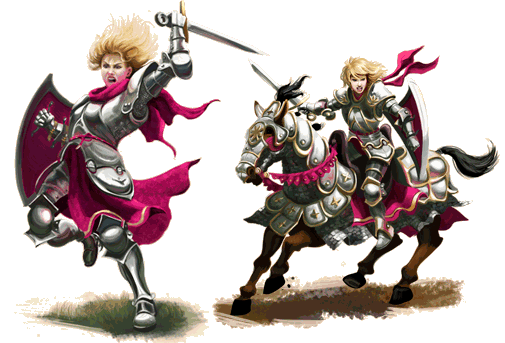 The final preview of the BattleLore Heroes Expansion characters has just been posted over at Fantasy Flight Games— the Warrior hero, who, as expected, is an aggressive hero and a good choice for newbie players who don’t want to bother too much about subtle tactics!
I’m a bit surprised to see that the Warrior illustration is female, for two reasons. One, with the exception of Joan of Arc, woman weren’t involved in warrior roles in battles during the Hundred Years’ War, which is the historical period BattleLore is ‘based’ in (with fantasy additions, of course). I have nothing against more sexual equality in gaming stereotypes, but this seems to underscore the fact that BattleLore may be getting a bit more Dungeons & Dragons and a little less ‘alternative historical’, which I personally think is a shame.
Two, my pre-production figure of the warrior seems to be male. Of course the figure may have since changed, or the plate armour is just too heavy to really tell!
Anyway, back to the skills. The Warrior doesn’t muck about on the sidelines, but takes on enemies, whether heroes or troops, face-to-face, and she has no interest in Lore either. She has six skills to choose from up front; no prerequisites.
 Of course, she has Riding like all our other heroes. It is recommended that this skill is avoided until her other abilities are developed, however.
Path Finder is the same as the Rogue skill, and allows her to ignore terrain movement restrictions and move one additional hex.
The remaining skills are combat-oriented. Assassin—also, somewhat strangely, a Rogue card—adds a die when battling an enemy Hero in melee combat, and adds damage when a hit is scored. I think this would have been better renamed for the Warrior, but that’s a small nit-pick.
 Blademaster is another shared skill with the Rogue, adding one additional die in melee combat, while Hack-and-Slash (yay, a unique Warrior skill at last!) gives the Warrior two additional dice. That’s more like it!
Her last skill is Bruiser, that allows each Sword-on-Shield (Bonus Strike) result to be rolled again until no new Sword-on-Shield results are rolled. Lore results rolled on the extra dice are ignored.
All-in-all I found the Warrior to be a little uninteresting, with her reliance on Rogue-type skills, and I think the visual treatment would have been much better suited to a burly medieval warrior-in-armour-type, even though it’s a bit of a cliché. Personally I’d like to see BattleLore’s unique Hundred Years’ War setting retained and emphasized, rather than see this generic American fantasy look creep in. Still, it’s going to be a great expansion!
Of course we have yet to se what special Artifacts—probably weapons—the Warrior can wield. Hopefully Artifcacts will be the subject of the next post!
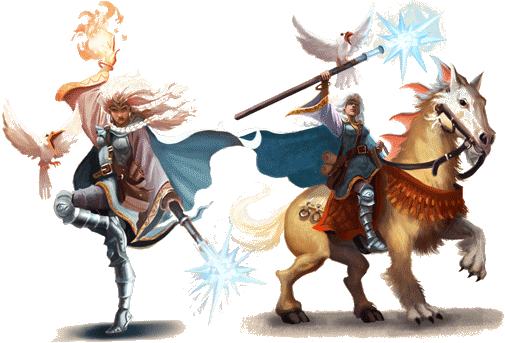 The BattleLore Heroes Expansion news continues with a look at the Wizard hero, who harnesses the arcane arts for death and destruction.
We certainly have a different look for the Wizard hero here; a flamboyant pastels-and-armour-garbed woman with a strange bird familiar, fireball, sparkling wand and a riding beast that’s a cross between lion and horse! It’s a little much for my taste, a bit too Dungeons & Dragons, but others may disagree.
 But the important thing is what she brings to the BattleLore battlefield. And it looks pretty tough. The Wizard uses offensive strategies and is best taking on enemy heroes or normal troops. She can also take more equipment into battle by summoning a servant or utilizing her skills in alchemy. For the player who wants to get his hero up in the front lines dealing damage, the Wizard is a good choice.
 She has five skills to choose from at the beginning; one requires a prerequisite but is only a support skill.
Of course, there’s the usual Riding skill, apparently not as useful to the Wizard as it is to other players, unless she is wielding an artifact that requires quick movement around the battlefield.
Of the remaining skills, two allow the Wizard to equip differently before the game, while the others are offensive spells.
Alchemist allows the Wizard to use a potion more than once (they are usually discarded after use). The maximum number of usages per turn is always one, however, and the skill only alows two ‘repeats’. Potions appear to be included under the heading of ‘Artifacts’. We learn that heroes start the game with a single Artifact, and that the usual maximum number a hero can carry is two.
 However, Unseen Servant allows the Wizard to take three Artifacts into battle. This seems very handy, as artifacts appear to be quite powerful—and the Rogue has a skill that allows him to steal one from the Wizard.
 Now it’s time for a bit of offensive magic!
The not-so-subtly-named Destruction lets the Wizard destroy an opponent hero’s Artifact, if they are in melee combat and the Wizard gives up all Lore rolled (minimum 2). This could really annoy your opponent, taking away a powerful item from his arsenal early in the game.
Ball Lightning allows a Wizard in melee to cause a hit by using all the Lore symbols she rolls. You can add the skill Lightning Arc to this and share the ability with a friendly adjacent unit!
According to the article, the Wizard is therefore more powerful when leading a troop, and they recommend keeping her with a red banner unit so her powers can be best utilized with the larger offensive dice pool.
Only one left: the Warrior!
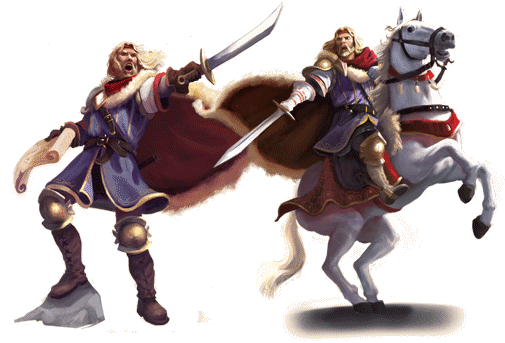 More BattleLore Heroes Expansion goodness this week with a preview of the Field Commander hero.
 Our new commander is a rather flamboyant blonde warrior in red and purple, somewhat younger and less encoumbered by armour than we’ve been used to. I liked the old white haired, hard-bitten character myself, but a change is good.
 The Field Commander is for those players with a focus on their army; he uses his skills to help other units. He seems to be quite a fighter in his own right as well. Like the Rogue, all of his 5 class-specific skills don’t require skill prerequisites, but are available from the start of the game.
Like other heroes, he has the Riding skill. This seems to be an important first choice for the Commander so he has the mobility to effectively use his other skills where they’re needed on the battlefield.
 Outflank is another movement skill. Your Commander can be ordered out-of-section of using an order from a section Command card. This means that if you have the Riding skill, your Commander will always been on the move.
 The Blademaster gives a bonus to melee battle dice—though no additional casualties like the Rogue skill of the same name.
Call to Arms requires that your Commander be adjacent to a supporting unit, and adds two dice to his combat roll (though the supporting unit can’t battle that turn).
Now, a couple of skills that improve your Commander’s Command!
 Scouting lets you draw three replacement Command cards and keep one after your Commander is ordered by a scout Command card, giving you some extra flexibility in your command choices.
And finally, Lead by Example allows the Field Commander, when ordered by a Scout card, to order up to 3 contiguous units (as long is one is adjacent to your Commander).
Great stuff to reduce the vagaries of luck and put the control of command back in the player’s hands.
Coming up next, the Wizard.
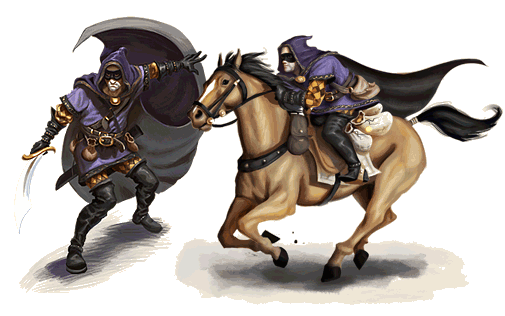 The lead-up to the long-awaited release of the BattleLore Heroes Expansion continues with a look at the Rogue hero.
 New artwork for the Rogue sees a male version dressed in purple-lined cloak, mask and rather fetching thigh-high leather boots. All the rage in Uchronia this season, I’m sure!
The focus of the Rogue is targeting and disrupting your opponent’s hero—but of course, in a sneaky way. He’s not going to last if you go up against your opponent’s Warrior in combat.
 Unlike the Cleric, who has a skill selection limited by rerequisites, the Rogue has a full complement of skills to choose from.
The Riding skill returns, a skill that all heroes have in common, though it appears its effects can vary for each hero. In the Rogue’s case, it increases his movement to 4 hexes, but is also required for the use of other skills (just how it does isn’t clear at this stage).
 The Pathfinder skill allows the Rogue to treat all terrain—even impassable terrain— as though it was clear countryside. He still can’t end his move on impassable terrain however. Very handy indeed. Like Riding, it also sets up the use of other skills.
Right, onto the all-important combat skills!
Assassin gives your Rogue an extra battle die in melee combat against another hero (hero versus hero combat—excellent!).
 Blademaster gives you the extra battle die in general melee combat. In addition, if you roll at least one hit, you roll an additional die when making the Casualty Check.
The article’s suggestion for these skills to wait until you can see how your opponent will utilise his hero—whether they come to the fore to offer combat, or stay hidden in the ranks instead.
The last two skills are Leech and Thievery.
 Leech allows the Rogue to still the Lore that an opponent rolls when attacking a Rogue. Yeah, not that exciting, but we have yet to see how Lore works in relation to heroes. And you have to be attacked to use the sill, so as the article suggests, you should postpone selection of this skill until a bit later in the hero development process.
Thievery allows the Rogue to steal one artifact when in melee with an enemy hero, after spending a minimum of 2 rolled Lore. This is the first mention of artifacts, which sound exciting. Each hero begins the game with one, but it appears that more can be taken as a hero develops.
Next up for discussion is the Field Commander.
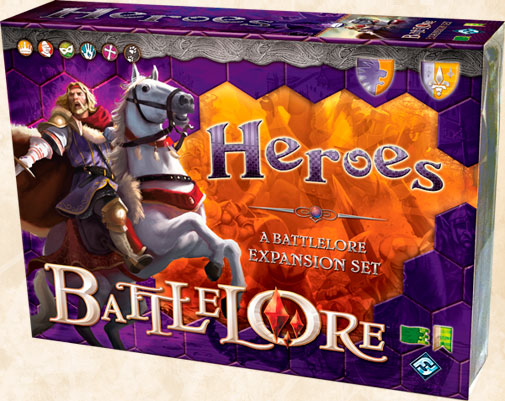
A lot of BattleLore fans have been waiting for this one for a long time. I’ve got a set of Hero figures I’ve had for ages that I’d love to show you, but can’t (it will be interesting to see if they match this release). People were beginning to wonder if it would ever happen. But at last, Fantasy Flight have announced the BattleLore Heroes Expansion.
 Coming this Fall, Fantasy Flight Games is proud to release the long-awaited expansion for BattleLore, BattleLore: Heroes. In this expansion, leaders and champions will be called to the fields of battle to aid their sides with new skills and artifacts. The road to adventure and glory is never easy and fledgling adventurers will begin their campaigns with only the barest of abilities and must survive the harsh realities of war to become a legendary hero.
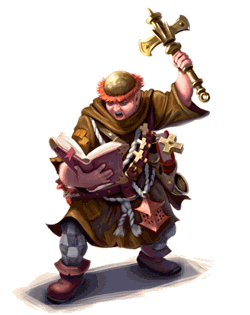
The first review looks at the Cleric, and it’s notable that Fantasy Flight has moved away from the ‘classic’ goblin Cleric to give us a human version. It certainly is strange to finally see new artwork for BattleLore, but happily, the look is very similar to past illustrations, so there’s been no jarring change in the game’s graphic style.
It would appear that Heroes start with an initial skill selection, which are either bought or played with the expenditure of Lore tokens.
 The Riding skill tells us that each hero will come in mounted and unmounted versions (something I already knew from my figures).
 It’s also clear that Heroes develop over the course of a game, and that certain skills require other skills as prerequisites.
The Chant skill allows the Cleric to force attackers to roll one less battle die when attacking the hex he is in.
If players learn this skill, they have access to a stronger version called Battle Hymn, which extends the effect to adjacent hexes.
 The skill called Herbal Remedy, similarly, is the prerequisite for two other skills. The skill allows the troop a Cleric is leading to ignore a hit. Prayer for the Dying and Healing Hands expand on this skill; one for when the Cleric is alone and one for protection of an adjacent troop.
We are told that the Cleric has the potential to shine in the early game, especially against an offensive hero that is still undeveloped, “since the Cleric can potentially be able to stay off the field of battle longer and accumulate more experience.”
Obviously getting your heroes in amongst it at an early stage of the game can slow their rate of development, which implies some interesting strategic choices.
 BattleLore: Heroes is coming Fall 2009. Listed price is US$39.95.
Here’s the information from the FFG product page:
BattleLore: Heroes introduces player-created Leaders and Champions to augment your camp’s forces in battles.
As with all journeys, the beginning is never easy. As a fledgling adventurer, you begin with a bare minimum of skills and artifacts to help you combat the enemy. Adventures have the potential to reward your intrepid Hero greatly if he performs well. But beware, battlefields are not without peril, and taking too many wounds may force your Hero into an unwanted early retirement.
Prepare yourself for the journey of a lifetime!
BattleLore: Heroes includes 10 unique Hero figures, a Rules booklet, 110 Skill, Artifact, and Landmark cards, and much more!
Next time, we’ll be getting a look at the Rogue hero. Great to see BattleLore back in action again.
Richard Borg has made this post on Fantasy Flight’s BattleLore message board about possible upcoming releases for BattleLore. It does look like the long-awaited Heroes expansion is next, and there are two other expansions in the works that he can’t yet talk about.
He also reveals that his team have playtested material for a whole range of new armies from various fantasy ‘cultures’: Dwarf Culture (Shadow Army, Dwarven Lords); Elf Culture (Forest Elves, Shadow Elves, War Elves); Goblinoid Culture (Ork—or ‘Torks’, a combination of Troll and Ork discovered in Greenland by Barbarian Raiders); Human Culture (Barbarians, Tribesmen, Ice Army, Man’chines, Wolven Migration); Rat Nation, Reptilian Army, The Swarm (Bugs); and a Necromancer Skull Army.
Plenty to keep BattleLore going for a long, long time yet…
Fantasy Flight Games have posted a brief FAQ about the future of BattleLore. Excitingly, the ‘Hereoes’ expansion is planned for release this Fall. The FAQ is reproduced below:
Q. Will FFG release be a new edition of BattleLore?
A. Not for the time being. We intend to support the current game system and theme for quite some time.
Q. Is FFG planning to release the BattleLore expansions that DOW already had in the works?
A. Yes, we will be releasing the expansions which were already being manufactured by DOW. These are the Heroes expansion and For Troll and Country, which we hope to ship sometime this Fall.
Q. When will FFG be shipping existing BattleLore products to distributors and retailers?
A. The inventory is currently being transferred to our warehouses in U.S and Europe. Once it is settled there, we will resume supply to the marketplace. We expect this to take another 2-4 weeks.
Q. Which logo will be on BattleLore products in the future?
A. The existing inventory, although sold by FFG, will still carry the DOW logo. With an eventual reprint, this will be changed to the FFG logo.
Q. Will Richard Borg be involved in the development of new content?
A. Yes, we are very excited to be working with Richard on creating new content and products for BattleLore.
Q. When will FFG announce their future plans for BattleLore?
A. We intend to have more details on our support and release plans for BattleLore around the time of the Essen Game Fair (towards the end of October.) Around that time, please stay tuned to the FFG website for more information.
Q. What will become of BattleLore’s online presence?
A. We will be working on taking over as much online content from the DOW BattleLore site that we can. Unfortunately, we will not be able to execute a simple and quick port of the existing scenario editor and scenario database, as the software for this is understandably proprietary and integral to DOW site. We are working to come up with a good solution for this problem and we think that the fans will be happy once all is settled. Please note, however, that this will take time and that we appreciate your patience in this.
FFG will be unveiling our own BattleLore website sometime in September, to which content will be added on a regular basis.
Days of Wonder announced today the Operation Overlord and ‘Hedgerow Hell’ Overlord BattleMap expansions for Memoir ‘44; and the ‘Troll Map’ Epic Adventure expansion for the BattleLore game system. All three expansions will make their debut this week at the Gen Con gaming convention in Indianapolis.
This first release of the Epic Adventure Map series for BattleLore includes a large scale Epic map featuring two Epic Adventures—For Troll & Country and Troll Bridge. The paper map is 47 x 34 inches (120 x 87 cm) and comes ready to play with terrain, obstacles and unit positions pre-printed. Players can just place their BattleLore units and start their adventure. This volume also features the new Troll Creature figure, perfect to use with these or other adventures.
The BattleLore Troll Map Epic Adventure expansion is expected to be available worldwide in October. Suggested retail price for the Troll Map expansion is $18 and €16.
For the official page at DOW and pictures go here.
For the info on the Memoir ‘44 expansions go to tabletopgamingnews.com.
The French site 4Ludique is featuring an excellent video that gives us a detailed look at the first wave of BattleLore specialist packs, including the larger 100 Years’ War pack. In French of course, but a translation of the 100 Years’ War part of the video has already been posted here.
 Boardgame News brings us previews of the specialist packs, including the first detailed looks at the 100 Years’ War and Goblin Marauders packs.
Thought Hammer already has a listing for the upcoming Goblin Marauders pack. We should take this with a grain of salt however, as the contents listed appear to be for the Hundred Years’ War pack, and the cover illustration shows, along with the Goblin cavalry we’ve already seen, the musicians already in the Goblin Skirmishers pack. Early art, or do we get more musicians in the Marauders pack?
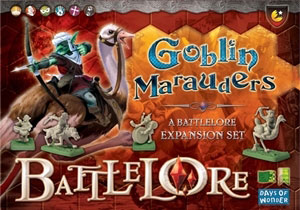 Anyway, the Hundred Years’ contents, as given here are listed as:
32 new figures, including:
4 Halberdiers
4 Horn Blowers
8 Spearmen
16 Arbalestiers
14 New Banners (7 for each camp)
Rules Booklet (plus Medieval Lore rules)
4 New Battles (Crecy, Cocherel, Patay and Poitiers)
Bonus Revisit to Agincourt in Epic Mode
6 New Specialist Cards and 4 Weapon Summary Cards
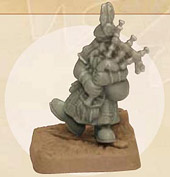 We’ve had goblin drummers, and now the latest post on the official blog site introduces us to the second of the specialist musician figures for BattleLore: Dwarven Bagpipers!!
 Fittingly, the pipes don’t raise the morale of troops like the goblin drums, but instead sow fear into the hearts of Dwarven enemies.
“Arms wrapped around the goatskin bag and fingers busily playing the chanter, the stout little fellows never get the chance to draw a weapon!
 Curiously, those foolish enough to dismiss them as a result are often last seen running for their lives, off the battlefield…”
This makes the bagpipers very interesting to use, as they don’t actually cause any damage on the battlefield, but instead open up all sorts of possibilities to exploit the morale of opposing troops—especially goblins!
Of course, if you happen to be facing the Earth Elemental, which ignores all flags, that won’t do you much good …
Not only that, but Dwarven bagpipers come in all colours, leading to interesting choices and trade-offs during deployment.
Eric has announced in a comment on an official blog entry that owners of two sets of BattleLore who want the Epic expansion will be able to get it for free, excluding shipping and handling. More fantastic support from Days of Wonder!
Update: Check out the Days of Wonder store for information about this deal.
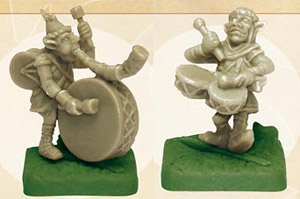 The latest post on the official blog site introduces the first of the specialist figures for BattleLore: Goblin Musicians!
New units and figures like the musicians are deployed with the use of Specialist cards. Continuing the advantages of the card deployment system over normal point-based systems, normally only 2 Specialist cards will be allowed for each player, which stops one player ‘out-purchasing’ another and filling up their army with special units, but still allows for a lot of choice and unit flavour.
 The first specialist unit to be released is the Goblin band. Goblin musicians can be fielded in one of two ways—first, as a complete band (band leader and three drummers), which gives a Support presence, or half the support required for a unit to be fully supported (Bold) to all friendly units in the same Section of board (or both sections if it is on a dividing line). Second, as individual drummers embedded in existing foot units to make that unit Bold.
Musicians enbedded in a unit are removed as casualties when the controlling player decides, ie. usually as the second-to-last figure before the banner bearer.
It looks like this new mechanic of embedding specialist units within other units will become a common feature of BattleLore as it expands further. I wonder if Heroes will be embedded in units this way, or be free figures on the battlefield?
Thought Hammer are listing the contents of the upcoming Goblin Skirmishers and Dwarf Battalion Specialist Packs.
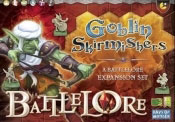 Goblin Skirmishers
1 Goblin Band Leader
3 Goblin Drummers
8 Goblin Spear Bearers
8 Goblin Slingers
10 new Banners
Rules Booklet with 2 new adventures
4 new Specialist cards and 4 new Weapons
Summary cards
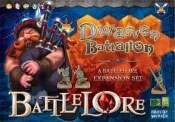 Dwarf Battalion
4 Iron Dwarf Bagpipers
8 Iron Dwarf Spear Bearers
8 Iron Dwarf Axe Swingers
14 new Banners
Rules booklet with 2 new adventures
3 new Specialist cards and 3 new Weapons
Summary cards
Check out this brief review of the upcoming Call to Arms expansion!
 The latest post on the official DoW blog gives us more insight into the workings of the exciting new Call to Arms expansion.
The Call to Arms rules are used to create customised armies when only the battle map’s terrain has been defined. (Note we can see on this sample map new ‘ridges ‘terrain, which will be included in the expansion.)
 There are two drafting modes: Impromptu, for friendly, short set-up time sessions; and Organised, for veteran gamers wanting more control.
The mechanics are designed to simulate medieval deployments by using the concept of Battles or Guards: the vanguard, which led the column of troops on the march, the middle, which followed, and the rearguard, which closed the column.
These Guards would then deploy abreast opposite the enemy, with the vanguard moving to the right wing, the middle to the centre and the rear to the left.
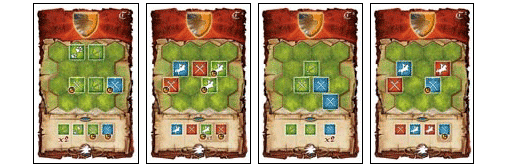 Players draw Deployment cards to specify the type and composition of these units. Choices may be influenced by the terrain (units deployed on impassable terrain must be instead deployed on your baseline or first row of hexes); your reserve (a card held in Reserve cannopt be fully deployed; instead two of units are deployed on your baseline); and initiative (cleverly, the player with the most Green units outside of his Reserve ‘out-scouts’ his opponent and starts the game)
 In Organised mode players choose their own decks to draw from, and if you cannot raise the troops you’d like from the common Army pool when they need to be deployed, you’ll have to call on Feudal Levies, represented by Feudal Levy tokens of the appropriate colour. During deployment these are exchanged for units of equal or lower rank.
 Specialist cards introduce another interesting aspect to Organised deployment, allowing you to develop interesting card combos (though you can only select two per game) to modify the deployment process and complement your troop or War Council selections.
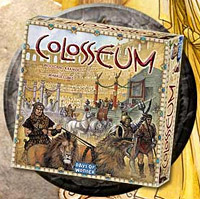 It’s a bit off-topic, but we couldn’t help mentioning that the website for Days of Wonder’s new game Colosseum has gone live.
From the press release: In Colosseum each player is a Roman impresario—producing great spectacles in his or her arena in the hopes of attracting the most spectators. Players earn wealth and glory for each event run, using it to create ever more ambitious events. They will need to improve their arena, find the best performers, lure the Emperor and his nobles, and manage assets for long-term success to be granted the title of Grand Impresario … Days of Wonder has designed Colosseum to provide the timeless feel of a German style board game.
At the new Colosseum site you can read this press release in full and download an interview with the game’s designers, Markus Lübke and Wolfgang Kramer.
Some preview images here. Now back to your regular BattleLore news!
 Things have been quiet for a while on the Days of Wonder official blog, but all is forgiven, as they are busy shipping BattleLore out to us eager customers!
Check the blog post for the full details, but basically, in Europe, BattleLore went out to European distributors, and those who pre-ordered from DoW, earlier this week and should be on the shelves by December 8. In the US, BL went out last week, and distributors will start shipping to retailers on Dec 4 and should be on the shelves by the end of next week. In other countries—Canada, Australia (yes please!), etc—they’re heading out this week, but when we actually see our copies is up to shipping and distribution factors.
Also, there’s additional information on ordering Earth Elementals direct from DoW, and the cut-off date for the Hill Giant promotion for US pre-orders has been extended to Dec 6. Plus you’ll get your Earth Elemental.
For all the details, check the blog post. Next, information about demo kits for stores and volunteers running events.
Things should start hotting up here at BattleLoreMaster once we finally get the game in our hot little hands. Expect some exciting changes to the site in the weeks to come!
Some lucky European Boardgamegeek members have received emails telling them their pre-ordered BattleLore from Days of Wonder was shipped on the 25th of November. BattleLore is coming!
Patrick Korner chats with Eric Hautemont of Days of Wonder and the result is this interesting article, which gives us a good insight into the development process behind BattleLore, not to mention a few exciting tidbits about the future: Necromancer, anyone? Campaigns? Event and Creature decks? The future seems bright for BattleLore players!
 Days of Wonder takes the opportunity in their latest official DoW blog post to clear up some of the most commonly asked questions asked on forums about BattleLore. Hopefully this will finally quiet some of the endless debate that has been raging on their blog and Boardgamegeek about the promotional figures and DoW’s plans for expansions.
 I won’t repeat all the detail here, but basically DoW seems to be doing all it can to make sure everyone will have a chance to get both the Hill Giant and Earth Elemental promotional figures in their hands. In the US, the Hill Giant will be available to all those who pre-order BattleLore either from Days of Wonder direct, or their Friendly Local Game Store. The Earth Elemental will be available at gaming events, and also from the DoW website to registered BattleLore owners free of charge (save for a shipping and handling fee). In Europe, a limited number of sets of both the figures will be available to pre-order customers. For the rest of the world, these sets will be shipped with pre-ordered copies.
For full details, consult the DoW blog post. Personally, I hope this ends some of the whinging that has characterised discussion of the promotional figures (for example, one ridiculous ten page discussion on Boardgamegeek!) It must have been very frustrating for DoW to make these free figures available and then have to put up with the petulant demands of some of the gaming fraternity.
 Moving on, it is now confirmed that BattleLore is published and fully supported in English, French and German. Thanks to volunteers, Spanish, Dutch, Italian are partially supported via online resources such as the DoW blog. However, at this point there are no plans to publish versions in those or other languages. Also, the 80 page rulebook will not be released online as a PDF, though additional copies of the rulebook will be made available for purchase from the DoW site.
And now the stuff we all want to know more about: what are DoW’s plans for BattleLore expansions? The big news is that starting from March 2007, they plan to release 2-3 blister pack mini-expansions every month! These will be in the US$7-$12 range.
Intriguingly, DoW plans to “surprise and delight you” with memorable ‘tools’ built upon the foundations given in the core game, with the focus far more on D&D and roleplaying than Warhammer. In comments probably directed to those who fear the precedent of collectible miniatures games, it is pointed out that the idea is not to start an ‘arms race’ towards the most powerful armies and creatures; or to make customers feel that every expansion is a ‘must-have’ (though knowing myself and many other gamers, I’m sure most of us will consider them all must-haves anyway!)
There will also be two major expansions next year, one around (northern hemisphere) summer and one before Christmas.
And, last but not least, it is confirmed that although there will not be a points-based system, Richard Borg and the development team are creating an innovative and fun new approach to army building.
All in all, it seems the future is bright for BattleLore fans. Days of Wonder seems determined for the game to become something very much more than ‘just’ a miniatures battle game. Stay tuned here as BattleLoreMaster.com goes along for the ride!
 Here’s a good look at the Earth Elemental promotional figure, including his ‘Magic Pentacle’ Lair terrain tile.
Click for the large image.
 A good close up shot of the Hill Giant, for those of you who haven’t had a visit by him yet (including me!)
Click for the large image.
 The latest post on the official DoW blog talks about the world of BattleLore, Adventures and the BattleLore Online Adventure editor.
Europe during the Late Middle Ages is the stage for BattleLore adventures—”a period rich in major mass combat clashes, minor skirmishes and daring chevauchées … full of lively and colourful characters … [and] enough geo-political twists … and military and scientific innovations (cannons and gunpowder, astronomy …) to make anyone’s head spin.”
The Adventure Booklet is written from the point of view of one of the period’s leading chroniclers— Jehan (Jean) Froissart (c.1337 - c.1405); and is titled Vrayes croniques de France, d’Engleterre et païs voisins (‘Veritable Chronicles of France, Engelond and Neighbouring Countries’).
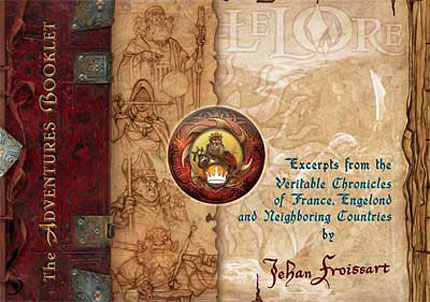
Of course, this being a uchronian Middle Ages Europe, things are not quite as they seem. In the BattleLore version of Froissart’s writings, monstrous creatures, mythical races and the mysterious power of Lore further enrich the already fascinating and exciting historical battles.
 Each BattleLore adventure is presented in the same format to facilitate rapid setup.
The format features the adventure’s Title (and date, when provided); a Battle Map depicting the lay of the land and the initial deployment of forces; a list of the type and quantity of Terrain; a list of key figures and supplemental units; and the Adventure’s Battle Notes.
 The Battle Notes give the players a background introduction to the adventure, a briefing section detailing known Commanders, Lore Masters and/or War Councils composition, the starting player, Victory Conditions and Special Rules.
 The Adventures in the base game are presented in order, progressively introducing players to all facets of BattleLore. A brief Apprentice section at the end of the Battle Notes lists the key new rules featured and references to their page number or chapter in the Player’s Guide.
It’s clear that the adventures presented have a high replayability factor. Different War Councils, Lore Masters and Creatures should change the way the battles play out considerably. Days of Wonder also promise more Adventures on the official BattleLore website. Hopefully, we’ll also be featuring as many unofficial adventures as possible on BattleLoreMaster.com.
 Accessible with the registration number that comes with every copy of BattleLore, the Online Adventure Editor is the same tool that Days of Wonder uses internally to develop and test their adventures. It should make the process of creating your own adventures remarkably painless. More detail about this is promised in a future entry.
Boardgamegeek are running a BattleLore Trivia Contest!
There are five multiple-choice trivia questions related to the world of BattleLore. For each correct answer (as determined by Days of Wonder) you’ll receive one entry in a random drawing to be held on Thursday, November 16th, 2006 to win one of three copies of BattleLore or one of twenty Earth Elemental Creature figures.
You may only play this contest once, for a maximum of 5 possible entries in the drawing (if you get all 5 questions correct), and as usual you have to be a Boardgamegeek member to enter. The odds of winning will be determined by the number of entries. Good luck!
 Reports are coming in of Hill Giants wandering the country!
Yes, the promotional Hill Giant figure has arrived, as anticipation for the upcoming release of BattleLore reaches fever pitch.
 By the way, Days of Wonder has been very thoughtful in supplying two identical Hill Giant cards so that you can either give one to each of the two players (and use their front and back for reference); or give two to the player controlling the creature to display both its front and back at the same time.
Click the images to get a look at the summary cards and terrain tile that come with the figure, and the figure itself.
I’m embarrassed to discover that the word Uchronia refers to a hypothetical, alternate-timeline period. It’s a word I hadn’t come across before. Possibly like many others, I assumed this was the name of the fantasy world of BattleLore. What Days of Wonder really meant by ‘a Medieval Europe Uchronia’ is an alternate fantasy version of our own medieval period.
The latest post on the official DoW blog looks at the hex tiles that add variety and strategic options to the battle board: Terrain, Landmarks and Lairs. There are four basic terrain types in the core BattleLore set: Countryside (the board itself); Wooded Terrain; Elevated Ground and Waterways. I’m sure we can assume that additional terrain types will be coming in future expansions.
 Each terrain type (and each Landmark and Lair) has a corresponding Summary card where its effects on movement, battle and line of sight are detailed.
For example, this Wooded Terrain card tells us that woods block line of sight and a unit entering the wood must then stop, but may still battle. In addition, the terrain sometimes imposes a cap on the number of default battle dice a unit may roll when attacking into or out of the terrain (in the case of Woods, 2 dice).
 In general, rougher terrain limits the number of dice more; a neat device that reflects the effect on manouverability and combat effectiveness that such terrain has on a ‘heavier’ unit.
Note this cap does not affect bonus dice from Lore or Command cards or any other source.
Landmarks are distinctive battlefield features built by the hand of man, and have a number of basic effects: they block line of sight, their occupants may ignore a flag and possibly battle back (ie the unit becomes Bold), and a unit must stop and cannot battle the turn it enters a landmark.
 You can see they also cap battle dice in the same way as Wooded Terrain.
However, they often also convey unique advantages. The sole owner of a Level 3 Lore Master receives a unique Landmark for that Lore Master.
For example, a Level 3 Wizard receives the Magic Pentacle shown here, which lets the player collect a Lore token at the end of each turn during which that player’s troops occupy the Pentacle.
 A Level 3 Rogue receives the Rogue’s Den shown here, allowing the player to establish a secret one-way passage to a Wooded or Elevated terrain hex.
The Den is placed in any empty hex on the third or fourth row from your side (it’s not yet clear whether this placement rule applies to all Lore Master landmarks).
 Any player with a Level 3 Commander receives the Stronghold, which makes any friendly troops adjacent to it Bold, but also forces you to lose a precious Command card if it is taken by the enemy! A bit of a mixed blessing perhaps..?
 Finally, Creatures also come with their own Lair (we can see here how the Hill Giant and Earth Elemental blister packs come with their Lair tile and Summary card in addition to their Creature summary cards) from which they emerge during the battle. Here we see a Circle of Summoning, from which troops may attempt to summon the Earth Elemental into an adjacent hex.
Days of Wonder:
Photos here.
Boardgamenews:
Report and photos here, pics here, here and here (Agincourt scenario); Days of Wonder booth here; designer Richard Borg here. Day One video: Brief look at BattleLore starts at 2 minutes into the video.
BoardGameGeek:
Impressions and reports here, here and here; lots of pictures in the image gallery here.
Kulkmann’s Gamebox:
Report with photos here (about a third of the way down the page).
Naturelich Games:
Two photos here (shows the thickness of the box well).
Jeux de Nim:
Photos here and excellent photos of the sample painted miniatures here.
 The French website TricTrac has posted one of their ‘wacky’ box-unpacking videos, giving us a close—albeit high-speed—look at the packed contents of a BattleLore box (Flash plugin v8 required). That thick colour rulebook looks great.
It certainly gets across the excitement of opening a new game, but personally I wouldn’t let ‘Monsieur Phal’ anywhere near my precious games!
 On Oct 13 the official Days of Wonder BattleLore site was launched at Battlelore.com. Not only do we see our first glimpses of the Hill Giant and Earth Elemental promotional figures and their packaging, but the BattleLore Primer is available for download (3.5Mb). This lavishly illustrated and designed twelve page document (available in print from game stores) gives us a good overview of the game, a glimpse of some more detailed game elements and a good look at what comes in the box. Beautiful stuff and essential downloading for any interested gamer.
In addition, pre-orders from the DoW website are now available. The battle has almost begun!
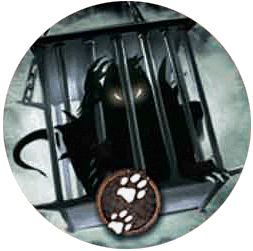 On October 16, the last game-related post on the official DoW blog covered Creatures in BattleLore.
Creatures in BattleLore are rare, but dangerous. A Giant Spider will be coming with the base game, and of course the special promotional figures, the Hill Giant and Earth Elemental, also fall into this category. They are brought into play at the cost of a Lore Master level token just like Lore Masters, as described in that entry—which makes them valuable battlefield assets not to be misused!
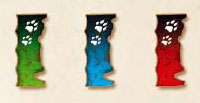 Creatures have a distinctive banner shape, as shown. They are represented by a single figure with a large hex-shaped base, but considered a unit for game purposes.
Creatures are eliminated only when they receive a Critical Hit. When attacked, any dice that would have normally scored a hit are set aside and rerolled—only if the creature’s banner colour (Bonus Strikes don’t count) comes up in this second roll is it eliminated (and the victor receives both the Victory banner for the kill and one Lore token from the Lore pool).
 Not only that, but Creatures can be ordered if in a different section from the Section card just played Out-of-Section Ordering at a cost of 3 Lore tokens.
Creatures are Bold, but must always ignore one Flag rolled against them (ie, they can never opt to retreat, even when this is a preferable option).
For each Flag, the Creature must retreat 2 hexes (unless stated otherwise of their summary card); risking a Critical hit if it cannot. The attacker rolls a die for each hex of retreat ground not covered, and any hit that when re-rolled hits again, the Creature is killed.
If the Creature’s retreat is blocked by enemy or friendly units, they are Trampled, and lose one figure for each hex of retreat ground not covered. This affects both units if there are two blocking a Creature’s path!
Creatures provide Support to adjacent friendly units, but never receive the benefit of Support; aand do not benefit from a Morale boost when occupying a Landmark.
 Creatures also have Special Powers, which are detailed on their summary card and triggered by rolling the requisite number of Lore symbols. They can Power-up by temporarily storing Lore rolled in combat and unleashing, for example, a more potent Special Power later on instead of a lesser power right away.

 The Web and Poison tokens shown mark the victims of the Giant Spider’s special powers.
Some pictures of BattleLore in play have surfaced on Boardgamegeek.com, including our first glimpse of the giant spider figure (though it appears to be on the dwarves side!) and what looks like a goblin on the back of a lizard (no doubt what’s pictured on the box cover). Note the spider’s large hexagonal base. Also this confirms that banners come pre-applied. Imagine how good these games will look with all the figures painted … Pictures by Jens A. Czaplo


 The latest post on the official DoW blog is a much more indepth look at the War Council. We’re starting to see the level of complexity and the number of options that BattleLore players will enjoy.
At the start of a Lore adventure players assemble their personal War Council. It’s now obvious that one side of the War Council sheet shows the tent with a single Wizard; but the other side shows all of your potential Lore Masters gathered together. The players agree on the total number of Lore Master levels, and then assign Lore Master level tokens (shown at left) to the Lore Masters they wish to be in their Council.
 This total number of levels is specified in the adventures, but the recommended total is six levels. The sample shown (possibly taken from an adventure page) puts you in the role of Jean de Brosse, Marshall of France and Seigneur of Sainte-Sévère. (You can learn more about de Brosse, a French general of the Hundred Years’ War, here) In this case he has in his Council a Commander of Level 2 (which gives the player five Command cards); a Rogue of Level 1; and a Cleric of Level 3.
In addition, the level of your highest level Lore Master character (Cleric, Wizard, Rogue or Warrior) determines the number of Lore tokens you have in reserve at the start of the game; how many Lore cards you can keep from your intial draw of four; and how many Lore cards you can keep in hand and play from at any one time.
 Looking at the War Council sheet, we can see that in the case above, since the highest level Lore Master is a Level 3 Cleric, Jean de Brosse would be able to keep three of his initial draw of four Lore cards; will start with three Lore tokens in reserve; and may keep a maximum of four Lore cards in his hand at any one time.
Players also build different mixes of the common Lore card deck depending on whether there is a Lore Master of that class present on both sides (14 cards of that class), on a single side (8 cards of that class), or on neither side (5 cards of that class).
 Should a player wish to use a Lore card for which he has no corresponding Lore Master, he must pay a heavy price: it must be played out-of-character, which means that it will cost 3 more Lore tokens to bring into play, and it can only be played at a strength of Level 1.
The Lore Drain card on the right, for example, would cost Jean de Brosse five Lore to drain three Lore (1 x 1 +2) from his opponent, since he has no Wizard in his Council.
In true Days of Wonder style, all this information is neatly summarised on the War Council sheet.
 If Landmark rules are in effect and you are the only player with a Level 3 Lore Master of a particular class in your Council, you will enjoy the benefit of a unique ‘family property’.
Shown at left is the Healing Pool, the privilege of a Level 3 Cleric, such as de Brosse has in his Council.
And finally, you can also use Lore level tokens to bring a Creature to your side; the wielders of fearsome powers to be revealed soon (the Hillgiant and Earth Elemental?). No doubt we will also soon learn the meaning of the mysterious Guest, who has a space at the bottom right of the War Council sheet.
Eric Hautemont of Days of Wonder has confirmed that they are not planning to release the entire BattleLore rulebook online. What they will release however, both online and in print, free of charge through retailers, is the BattleLore Primer, a 12 page document that sheds a bit more light on the game and its contents. It should go live by the 2006 Essen Game Fair (Oct 19 to 22).
Update: It has been revealed on the French forum that the base game will include ten Adventures (ie, scenarios). Two will be historical adventures and eight will be Lore (fantasy) adventures. Apparently the armies will be fixed in these scenarios, though different configurations of the War Council will make games play differently.
 Lore is the unique aspect of BattleLore that everyone is eager to know about. The latest post on the official DoW blog gives us our first indepth look at how it works.
Lore tokens (kept in a common Lore pool) are used as currency to fuel the legendary actions of the player’s legendary characters, the Lore Masters. (As an aside, that was a fortuitous choice of name for this site—I had no idea there would be a ‘Lore Master’ in the game.)
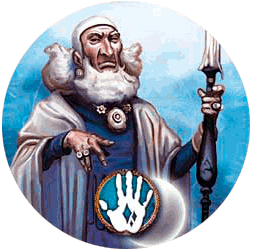 These advisors sit off the map on the player’s War Council sheet. They are the Wizard, Cleric, Warrior, Rogue and Commander.
It is implied that at the start of an adventure you will have to decide which Masters to invite to your side, and that the Masters can be at different Levels.
The Wizard allows the player to draw a single Lore token from the pool and ‘place it in a goblet’ to become your initial Lore reserve. (This goblet is no doubt the cup we saw in our first glimpse of the game set up here.)
You also must choice one from a draw of four random Lore cards from the Wizard’s Lore deck. (Since there are 60 Lore cards, and four Lore Masters that use them, it’s possible that each has a deck of 15 cards).
 Spells have a Name, a Power Cost (to be paid in Lore tokens when the spell is cast), a Phase of Play (when the spell may be cast), a Target, and an Effect.
The card also has a Lore Master Class symbol, which in this case is the Wizard’s Hand. The Spell shown is an expensive (7 Lore tokens) Portal, which allows you to teleport a target unit up to 3 hexes (+1 hex per Wizard level) in any direction to a vacant hex.
 The shot of the War Council sheet shown seems to be the top half of the sheet; the Wizard is shown in place, though it’s not clear if, since the Wizard appears to be printed on the sheet, he is a permanent part of any Council. Note that the map of the battle on the table is a BattleLore board.
With the Wizard, you may cast a Spell once per turn by paying the appropriate Power cost in Lore tokens. At the end of your turn, after drawing your Command card, you may either draw 2 Lore cards, selecting one and discarding the other, OR draw 1 Lore card and 1 Lore token, OR draw 2 Lore tokens.
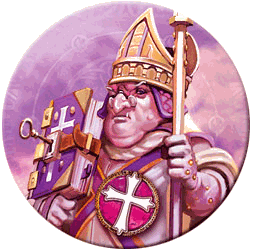 The four remaining Lore Masters are as follows. The Cleric can ‘soothe, protect and heal’, not to mention ‘wield a heavenly wrath upon his enemies’.
The Warrior ‘never seems to sleep, may lack a sense of humour, but his sheer grit and determination more than compensate’.
The Rogue is ‘cunning and nimble … a jack-of-all-trades. His talent lies in his remarkable resourcefulness and ability to disrupt the enemy’s best laid plans.’
 The Rogue’s Backstab card is shown, which causes Bonus Strikes rolled by your enemy to rebound against himself.
Finally, the Commander (shown here) does not play Lore cards, but instead dictates the size of your hand of Command cards.
The Lore cards and Lore Masters certainly add a whole new level of play to the Commands & Colors system, not to mention a whole new set of choices. A player’s selection of Lore Masters will influence the entire character and fighting style of his army. Next, we’ll hear about the War Council and, presumably, how you choose your group of Lore Masters and their Levels.
 The latest post on the official DoW blog talks about morale.
Troops are considered to be at a Normal level of morale by default, which means they retreat one hex towards their side of the board for each Retreat flag rolled against them.
As in the other C&C games, if a path of retreat is blocked, the unit loses one figure for each hex it cannot retreat.
 This behaviour can be changed by the morale level of the troops however. If the troop is Bold, it can ignore one or more flags.
If a Bold unit is engaged in melee from an adjacent hex, and it survives the attack and did not retreat, it may also Battle Back against the attacker (unlike C&C: Ancients, in which all units can battle back).
 Interestingly, you can boost a unit’s morale to Bold by supporting it with at least two friendly adjacent units. This has important ramifications, rewarding players if they keep their units in formation. It’s also pointed out that self-supporting triangular formations, as shown on the right, are particularly effective.
Units can be Bold, but they can also be Frightened, in which case instead of the standard one, they must retreat two or more hexes for each Retreat flag.
 They must also make a Panic Loss check; for each hex of retreat ground covered during a retreat move, the unit must roll one battle die, and any helmet rolled that matches their banner color forces the removal of a figure. All other dice results are ignored.
The morale states Bold, Normal and Frightened are summarised in the table above.
By default, Landmarks, such as this Camp, boost a unit’s morale to Bold when they are occupied.
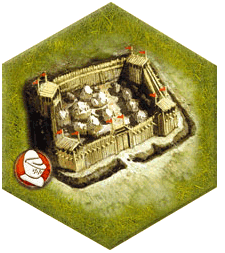 Morale is also affected by racial attributes—it seems that Dwarves are permanently Bold and Goblins permanently Frightened.
Following the above rules, a unit of Goblins may be naturally Frightened on their own, but when backed up by their fellows they become Bold and may ignore a retreat flag and battle back. More than one retreat flag however, and their nerve would break, forcing them to retreat two hexes per flag and make a Panic Loss roll.
Magic and Lore cards also modifer morale in as yet unexplained ways.
The latest post on the official DoW blog continues the discussion about basic game concepts, with an emphasis on the Battle dice and varies melee abilities.
 After reading the earlier post about the Battle dice, it would seem on first examination that the chance to hit units with a banner colour of red, blue or green is the same.
This post puts those assumptions to the test by pointing out the following factors: the number of dice a unit rolls to attack varies; some units have the chance to do damage on a Bonus Strike roll, and the Lore symbol can also affect damage.
 Interestingly, we discover that Lore symbols can do damage when combined with a Bonus Strike symbol roll—for example, a magical Long Sword. This surely opens up a huge range of possibilities.
It is mentioned that the units primarily fight in melee combat, and that ranged weapons are usually limited in effectiveness. Melee also features a number of Follow-on Actions. In melee combat (ie. adjacent hexes), a unit that destroys a unit or forces it to retreat can Gain Ground and move into the vacated hex (similarly to Take Ground in M’44) and a cavalry unit doing the same can Pursue by moving an additional hex and attacking again—which makes cavalry particularly mobile and deadly.
 A new concept, at least to M’44 players, then enters play: a unit that can ignore a Flag symbol is also Bold, and Bold units may Battle Back, (as they can in C&C:Ancients).
Therefore attacking a powerful unit exposes you to the risk of being immediately attacked right back!
The next post will discuss Morale, and how to boost and keep it.
 The latest post on the official DoW blog is a general one about gameplay, going over concepts familiar to Memoir ‘44 and C&C: Ancients. However, some of the ‘criticisms’ that are often levelled at the Commands and Colors system games are specifically addressed and discussed.
First we get a look at the sequence of play, which follows the usual order, however several follow-on actions are listed: gaining ground, pursuit, bonus melee attack and enemy battle back.
Gaining Ground and Pursuit probably have their equivalents in Memoir ‘44 as Advance and Armor Overrun; in C&C: A as Advance and Momentum.
In the latter game there is also a Battle Back option, like we see here, which reflects the more hand-to-hand nature of historical combat. This should certainly lead to more intense and protracted melee situations.
 The bulk of the post talks about the Commands & Colors system. Despite the fact that the game system works beautifully, some critics believe that the card-driven nature of the play detracts from the historical reality—why, for example, would you not be able to activate a unit on the right flank just because you don’t happen to have a card at that time that allows you to do so?
 The answer is part gameplay, part history. The card system rewards the strategic use of cards, forcing players to marshall their hand of cards in such a way as to be able to put their plans into action.
It’s pointed out that the cards could be thought of as a limited set of battle instructions you have for the battle; also that since the deck is used by both players, if your opponent has a number of left flank cards, you will have more opportunity to draw right flank (ie. opposite flank) cards; and that Tactic cards also give you an added level of flexibility. Historically, it’s obvious that battlefield communications were unreliable and that the chaos of battle is a factor. Whichever way you justify the system, there’s no denying it makes for a challenging, interesting game.
There’s also a mention of the battlefield hexes that are bisected by flank lines, and their tactical advantage since they lie in two sections and can thus be ‘activated’ more often. It’s pointed out that they can be hotly contested due to this advantage. I’m not sure of the historical justification for this, if any, but it’s another factor that has to be taken into account when formulating your play strategies.
 Finally, another War Council member is revealed: the Commander. We are told he dictates the size of your Command card hand, and indeed the same Command ‘crown’ symbol is on his token. Looking at the Rogue War Council member here, we see she has a ‘Mask’ symbol—what could this signify?
Some Section cards activate units ‘Equal to Command’, which is the number of levels allocated to the Commander. It’s beginning to look as though you can allocate levels among your War Council members to suit your playing style: to speculate, perhaps more to your Commander, allowing you to play more Command cards, but a corresponding lesser amount to a Wizard, giving you less strength in Lore—or vice versa. All should be revealed soon when the War Council is discussed.
 The official DoW blog has been updated with a look at the colourful Battlelore Battle dice. Basically, damage is determined by the colour of the helmet symbol, modified by Bonus Strikes, terrain, weaponry and Lore factors.
Coloured Helmet symbols count as hits against that unit’s banner colour, ie, a blue helmet rolled means a hit is scored against a blue banner unit, and a figure removed. The orange ‘sword and shield’ symbol is a Bonus Strike.
 This summary card for the Shortsword (click the cards to see larger images) shows not only whether the weapon is melee or ranged, but the type of damage, the chance of rolling Bonus Strike symbols, and any special rules.
Here we can see that the shortsword ignores one Bonus Strike if fighting cavalry. The long sword, which has greater reach, will count all Bonus Strikes against cavalry. A Bonus Strike is, of course, an extra hit.
 This Battle Dice summary card shows what the various symbols on the dice mean.
The Black Flag symbol is the familiar Retreat result, which usually means the unit must retreat one hex towards its own side of the battlefield.
The Stars symbol, which is also in the Battlelore logo, is treated as a miss in historical battles, and a Collect Lore Tokens (collect one Lore token) or Trigger Lore Effect result in Lore adventures.
Thus, for reasons that will no doubt be explained in future reports, it seems that lack of success in battle allows you to build up your Lore tokens (shown at right), and thus your ability to use magic or legendary actions. Apparently we’ll be learning more about Lore after a few more blog entries.
I’m not sure how this works thematically, but I assume it would certainly help to even out the luck factor, allowing those ‘unlucky in battle’ to be ‘lucky in lore’.
The official DoW blog has been updated with a post about the Command card system. There’s nothing particularly new here for players of other Commands & Colors games like Memoir ‘44, but we do get a first look at some BattleLore Command cards, and they look beautiful.
While in M’44 the two outer board sections are referred to as the Flanks on the cards, in BattleLore they are called the Wings. As we heard in the last interview, Scenarios are called Adventures.
 The two Section cards revealed are Scout (order 1 unit on the Right Wing) and Advance (for each Command card you have issue an order to one unit on the Left Wing). I haven’t seen the latter type of Section card in M’44, though perhaps it exists in the other C&C games.
The two Tactic cards are Blue Banners (for each Command card you have issue an order to one Blue Banner unit) and Darken the Sky (all units with ranged weapons can battle twice, but cannot fire at point blank or move). The latter card would certainly be handy in an Agincourt adventure … Apparently these two tactic cards have equivalents in C&C: Ancients.
 The red crown icon identifies the cards as being Command cards—linked to your Commander in the War Council. It’s been pointed out that the icon matches the icon on the ‘Outpost’ tile you can see here—does that make the tile a command outpost? More news on this as information on the Lore cards and War Council is revealed. Click the images on the left for a closer look at the cards.
While waiting for BattleLore to arrive, there’s still the other great C&C games to enjoy of course. A friend and I played the ‘Guam Landings, July 21, 1944’ scenario from the Memoir ‘44 Pacific Theater expansion last night. What a fantastic game! It came right down to the wire—with one Victory Point to win and no other options left, the Japanese made two suicidal charges on a tank unit in the hills—and they would have won too, if not for an unlucky roll …
Update: It’s been confirmed that the borders of the cards are white, which should reduce the minor edge damage that occurs with black bordered cards such as those in Memoir ‘44 after extended use.
There have been some requests from wargamers for a point system in BattleLore to aid in constructing your own armies and scenarios—just a quick note to say that Eric Hautemont of DoW has confirmed in the DoW English forums that this will not be in the base rules. However he has noted that some time next year we may see some kind of system, “though not necessarily along the lines people usually think off when they say ‘point system’”.
Mark Kaufmann and Eric Hautemont of Days of Wonder discuss the history of the company, their games, as well as their upcoming game BattleLore. Download the MP3 episode at Garrett’s Games and Geekiness Podcast or go directly to Garrett’s Games and Geekiness 33 to listen via QuickTime (via Boardgamenews).
Confirmed: the board is the exact same size as Memoir ‘44, double-sided. The regular side has slightly shifted (by half a hex) flank lines to M’44. The flip side has the same terrain but you can rotate it 90 degrees and line it up with another board to play ‘epic’ battles—thus making the epic game area more of a square. Even more web support is planned for BattleLore than M’44 (including epic scenarios).
Non-historical scenarios (those with magic and ‘legendary actions’) are called Lore Adventures. Lore cards are drawn from a separate deck from Command cards, and use a new mechanism—at the start of a game you are given, or can choose, a War Council, your ‘party of advisors in the field’ that give you special powers, and allow you to use certain Lore cards from the common deck. So you can choose powers based on the type of scenario, the lay of the land, the forces involved etc. You will have to manage a pool of Lore tokens to let you use your legendary actions when the time is right.
All these choices should mean that scenarios (now called Adventures) play very differently each time.
In the individual figure blister pack expansions you also get a summary card, plus a cardboard terrain piece that is the lair of the creature.
The box is 50% deeper than the normal Days of Wonder box, and the game is US$70.
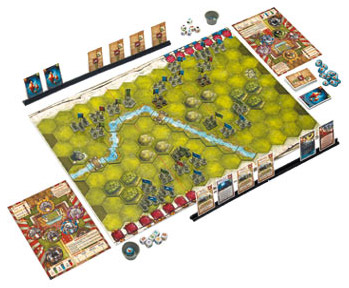 Asmodée Editions have given us the first glimpse of a BattleLore game set up and in action on a promotional page for the game—looks fantastic! It also mentions a ‘system of management’ in which the heroes play a large part—the War Council sheets? Can anyone give me a better French translation?
Click the thumbnail for a larger image.
Those War Council sheets look interesting … it looks like there are spaces for the large leader tokens (you can see one—the Rogue—on the Scenarios page). Each player also has a mysterious small cup with a die or counter in it. More news as it comes to hand …
The official DoW blog has been updated, giving us our first clear look at how a unit of figures will appear in a hex from above. This confirms that normal troops are four to a hex and mounted troops four to a hex: just like Memoir ‘44 infantry and armour. The figures appear to slot into the bases, which means a little extra work for the perfectionists among us (who, me?) filling in the base texture.
Troops are divided into three different types by the main colour of their banners: Green (Irregulars), Blue (Regulars) and Red (Heavy). Irregulars are untrained recruits armed with bow or stick and no armour, but very mobile; Regulars are trained military troops (shown with swords); and Heavy troops are less mobile heavy cavalry. It is noted that nothing in the system prevents variations on these categories however, so for example you could have ‘elite irregulars’.
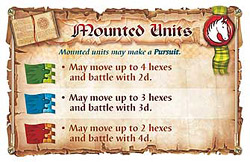
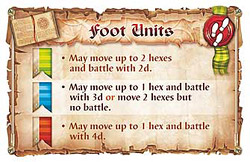 We also get a look at a new type of summary sheet, which shows the Move and Battle abilities of these types in a similar way to M’44. There’s a little more complexity here since each type of troop moves and battles differently depending on whether it is Green, Blue or Red. The Mounted Units summary notes that mounted units may make a Pursuit, which I assume is similar to an Armour Overrun in M’44; ie. after a successful attack the unit may move into a vacated hex and battle again. Imagery of heavy mounted troops mowing down fleeing peasants springs to mind!
 In the comments there’s some additional interesting information. All the races and unit types will have their own summary cards. Every figure base will have a hole for a banner, so banners can be assigned to any figure. The figures will come glued into the bases. Also note that the pictures are not of the same scale, so of course the figures themselves are in scale.
The system is looking simple but flexible so far: my kind of game! Images of miniatures are, as ever, compiled on the Game page.
From Eric Hautmont, Days of Wonder CEO: “… the figures in a hex will typically be in the 1-4 range (1 for big unique figures like the Creatures, 3-4 for infantry and cavalry units).
In terms of sizes of the sculpts, the dwarf is 22 mm from bottom of base to top of head. Humans on cavalry are about 30mm high from bottom of base to top of head, and the Hill Giant is 40mm+.”
This just in: “The units are dual color … gray figures but varying color for the base, depending on the race (gray base for humans, greenish for gobs …)”
The official DoW blog has just been updated with a look at the BattleLore miniatures. And the ones shown—a human heavy cavalry and a goblin archer—look stunningly detailed (love those textured bases). We’ve been told previously that that there will be fifteen different sculpts (humans, goblins, dwarves, and a giant spider figure) in the base game, and that the human figures will be about 25% larger than the Memoir ‘44 figures.
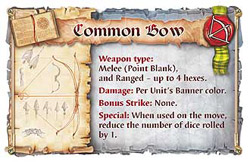 We also get a look at what looks to be a unit’s Summary card—in this case for troops armed with common bows. It has Weapon Type, Damage, Bonus Strike and Special headings.
We’re introduced to a key mechanic of the game—banner bearers. The banners themselves look to be of a sturdy plastic that can be attached to different figures like a peg, and the colour stickers that identify them look bold, colourful and clear. The banner’s shape identifies the ‘camp’ the unit belongs to; its base colour the level of training (mobility and combat-worthiness), and the weapons symbol identifies its special combat abilities. Once the figures are painted it certainly is going to be a spectacular battlefield.
The use of banners (and indeed, the whole concept of fantasy units on a hex field) reminds me of the old Milton Bradley/Games Workshop game Battle Masters, and indeed the similarity was mentioned in the Tom Vasel interview, though Eric Hautemont of DoW said the game was not an inspiration for Battlelore. In Battle Masters moreover, the banners were not only bizarrely tall and out of scale, but had no real useful game purpose.
Images of miniatures as they are released will be compiled on the Game page.